
24/7 Miner Monitoring Without Sitting in the Room
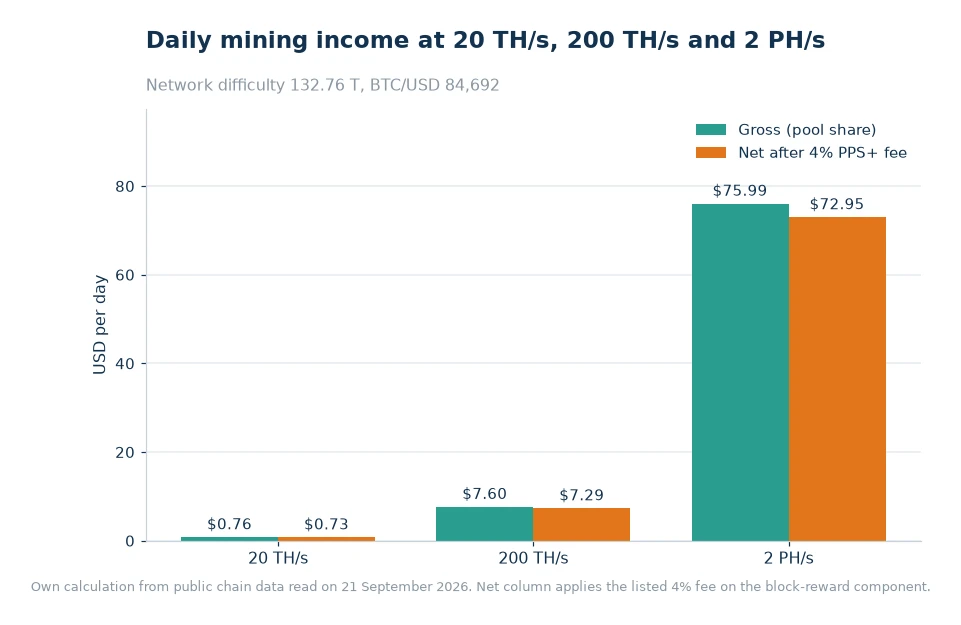
Monitoring is not about watching charts; it is about detection latency, and detection latency has a price. At today's difficulty of 132.76 T, 2 PH/s produces about $75.99 of gross income a day, which is $3.17 an hour — so an unnoticed fault that runs from Friday night to Monday morning costs roughly $76 before anyone notices. The same fault on a 20 TH/s rig costs 76 cents, which is why monitoring effort should scale with hashrate, not with machine count.
Key takeaways
- Convert downtime into money before choosing tools: 2 PH/s earns about $3.17 an hour gross, 200 TH/s about $0.32, and 20 TH/s about $0.03.
- A 24-hour blind spot on 2 PH/s costs $75.99 of output, while the same blind spot on 20 TH/s costs $0.76 — a 100x difference in exposure for a tenth of the hardware count.
- At 20 J/TH, a single 200 TH/s machine draws 4 kW: 96 kWh a day, or $5.76 at $0.06 per kWh, even when it is producing nothing.
- Payment cadence bounds how fast you notice a problem through your balance: PPS+ settles hourly, so a missed hour shows up in the numbers the same day.
Definitions first
Three terms do the work in any monitoring discussion. Detection latency is the time between a fault starting and someone knowing about it. Repair time is the time from knowing to hashrate returning. Uptime is 1 minus the sum of both, divided by the period you care about.
Most operators optimise repair time, because that is the part they can see. Detection latency is usually the larger number and the cheaper one to fix: an alert on per-worker hashrate costs nothing to enable, while shortening repair time means spare parts, travel and site access.
Network conditions set the stakes. With difficulty at 132.76 T, network hashrate near 1,003 EH/s and 450 BTC released per day, every terahash per second is worth about $0.038 a day at an $84,692 BTC price. That conversion turns monitoring from a preference into a budget line, and hourly settlement on a ViaBTC Bitcoin Mining account means a silent hour appears in the numbers the same day rather than at month end.
The trade-off nobody prices
Full-time eyes on a dashboard is not the answer either. Alert fatigue is real: a system that pages on every momentary share dip trains its operator to ignore it, and an ignored alert is worse than no alert because it feels like coverage.
The practical shape is a layered setup. Threshold alerts for hashrate, temperature and fan speed on the machines; a pool-side view that aggregates per-worker output so a partial fleet outage is visible without opening hardware interfaces; and a mobile notification path for the person who is not in the room. Alerting on the aggregation rather than on individual momentary readings removes most of the noise while keeping the signal that matters.
Two platform features make that layering cheaper. A mining pool dashboard shows pool hashrate, network conditions and per-worker contribution in one place, so a fault hunt starts with a single screen instead of a serial tour of miner IPs. Mobile apps with real-time hashrate monitoring, alerts and multi-account management cover the case where the operator is travelling, which is the situation where blind spots normally open up.[1]
Example with two setups
Both sites below run identical hardware and identical hashrate. The difference is how quickly a fault is noticed.
| Fleet hashrate | Gross per day | Gross per hour | Cost of 12 unnoticed hours | Cost of 24 unnoticed hours |
|---|---|---|---|---|
| 20 TH/s | $0.76 | $0.03 | $0.38 | $0.76 |
| 200 TH/s | $7.60 | $0.32 | $3.80 | $7.60 |
| 2 PH/s | $75.99 | $3.17 | $37.99 | $75.99 |
Site A runs 2 PH/s and catches a fan failure through an alert, restoring full hashrate two hours later. Lost output: about $6.33. Site B runs the same 2 PH/s and reviews performance at the end of the week; the same fault runs for five days, which is 120 hours of reduced output on the affected machines — around $380 of income for a fault that cost nothing to detect.
Now price the hardware rather than the outage. A 200 TH/s machine at 20 J/TH draws 4 kW, which is 96 kWh a day and $5.76 at $0.06 per kWh. If that machine keeps drawing power while producing no shares, the daily loss is output plus power: about $13.36 at current conditions. That is the number an alert should be measured against, and it is also why a Profit Calculator is worth a weekly check — efficiency, difficulty and price all move the breakeven line for older machines.
Practical next steps
- Write the hourly number on the wall. Divide gross daily income by 24 and multiply it by the number of machines you cannot physically see from where you sit. That is what every hour of silence costs, and it is the only number needed to justify a monitoring tool.
- Alert on aggregates. Page on fleet hashrate below a threshold, temperatures above one, and any worker reporting zero for more than a few minutes. Ignore one-off share dips.
- Match payout cadence to the alert path. Hourly settlement means a missing hour is visible in the account the same day, but only if someone looks at the account. Enable notifications instead of relying on manual checks.
- Record a baseline. Log hashrate, temperature and power per machine for a quiet week, then alert on deviation from that baseline rather than on absolute values.
- Review the fee structure once. PPS+ charges a listed 4% on the block-reward component and 2% on the transaction-fee component, while PPLNS applies a listed 2% to both; the smoother the payout, the sooner an outage shows up as a smaller number.
Frequently asked questions
Does the payout method change my average income?
It changes the variance and the fee, not the underlying expected value: your share of network hashrate still sets the ceiling.
How often should a miner check pool statistics?
Weekly is enough for cash flow, daily if you are reconciling worker uptime or chasing a hashrate fault.
What does a monitoring setup actually replace?
It replaces the interval between a failure and the fix, which is where the money is lost. On 2 PH/s the arithmetic is $3.17 an hour gross, so cutting detection from five days to two hours saves roughly $374 of output in this example.
Build the alert before you buy the machine
Monitoring is a capital decision disguised as an operational habit. Compute hourly output for the fleet you run, multiply it by the longest interval you would realistically notice a failure, and set that product as the budget for alerting. Then enable per-worker reporting on the pool side, install the app on the phone of whoever is on call, and confirm that a simulated fault reaches them within minutes. Sleeping in the room was never the requirement — knowing within the hour is.
Data and sources: ViaBTC pool statistics and mobile app documentation[1][2] and the listed fee schedule[3]. Network difficulty (132.76 T), network hashrate (about 1,003 EH/s) and the BTC price of $84,692 were read from public chain data and market feeds on 21 September 2026. All dollar figures are computed from those inputs and move with difficulty and price.